
Code of Silence: Is the LAPD Punishing Whistleblowers While Its Command Staff Goes After the Press?
An officer who exposed bigotry faces prison while command staff build files on the press — two standards, one institution
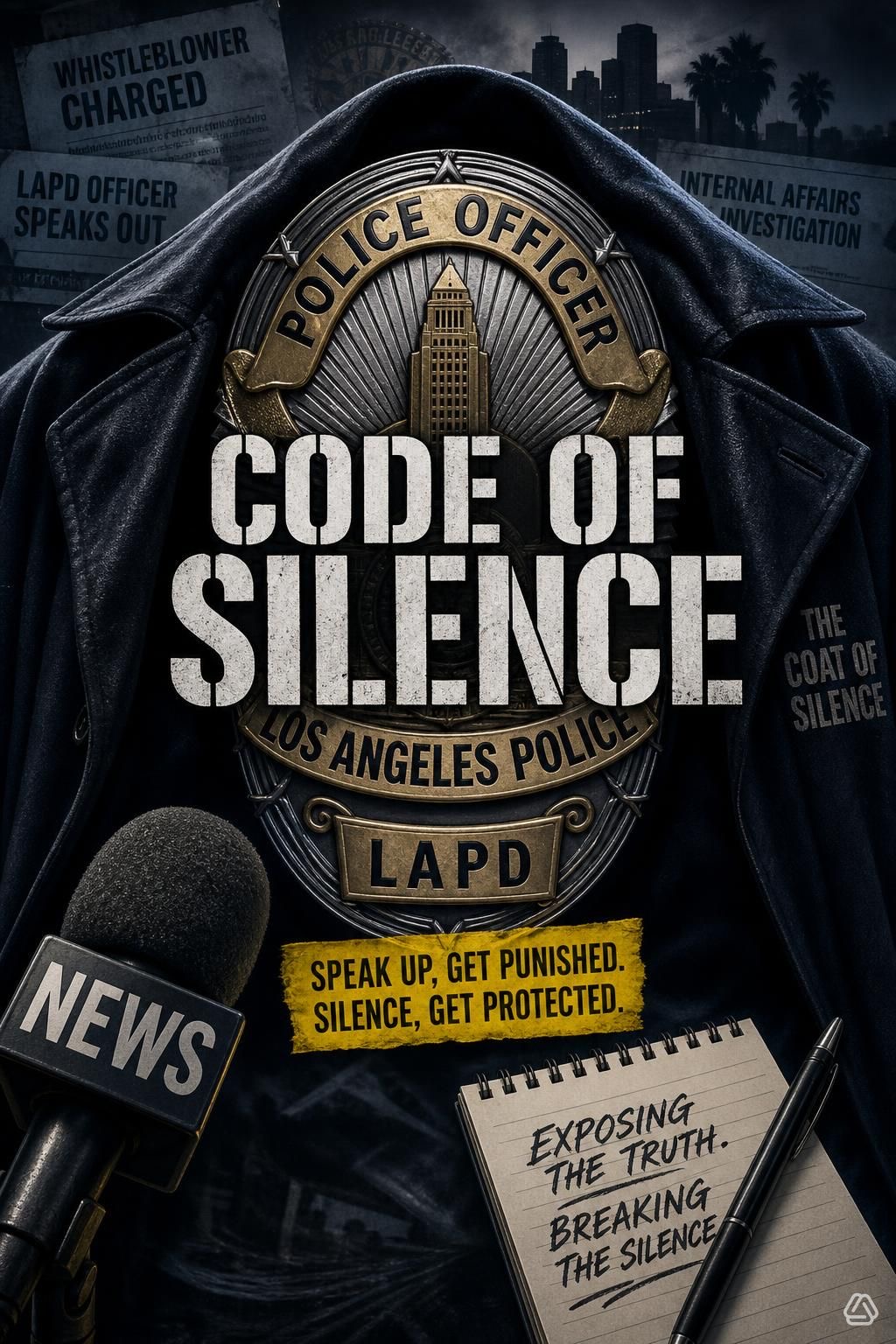
Two things are happening inside the Los Angeles Police Department at the same time, and taken together they paint a troubling picture: an officer who tried to expose bigotry inside the department is facing over a decade in prison, while the union representing command staff is telling its members to build files on the journalists covering them. If there was ever a textbook illustration of a "code of silence" — the practice of an institution protecting itself instead of the people inside it who speak up — this is it.
The Whistleblower: Daniel Flores
LAPD Officer Daniel Flores worked in the department's Recruitment and Employment Division, where he says colleagues — including a supervisor and a sergeant — routinely made racist, sexist, and homophobic remarks about coworkers and recruits. Rather than let it go, Flores secretly recorded them: 122 recordings in all, gathered as what he later described as part of what he believed was a lawful internal investigation. He submitted his complaints to LAPD Internal Affairs and the Los Angeles Police Commission in January 2025.
Instead of being commended, Flores became the target. Los Angeles County District Attorney Nathan Hochman filed 16 felony counts against him for illegally recording confidential communications — a charge that could carry up to 13 years in prison. Hochman has said the law applies regardless of Flores's motive. Prosecutors have also suggested in court filings that Flores had financial motives, alleging he referenced hoping for a payout from the department.
Even Mayor Karen Bass, while acknowledging that recording coworkers without consent is against the law, publicly warned that prosecuting Flores sends the wrong message and could discourage future whistleblowers from using internal channels to report serious misconduct.
Flores has said publicly that he believed the department would be proud of him — that he thought he was doing the right thing by keeping the matter internal rather than going to the media.
The Command Staff: A Different Standard for Scrutiny
While one officer faces prison time for recording alleged bigotry inside the department, the union representing LAPD's command staff — the Command Officers Association (COA) — has taken a very different approach to being recorded, criticized, and reported on.
In a notice to its members, the COA announced it has retained legal counsel to evaluate potential defamation claims against people the union says have made "egregious and demonstrably false attacks" on members' reputations "via news articles, social media, public comment periods, and other mediums." Members were instructed to submit recordings, social media posts, emails, screenshots, and other documentation of anyone criticizing them, so the union can forward it to attorneys for review.
The letter does concede, in its own text, that command officers are public officials — meaning any defamation claim would need to clear the "actual malice" standard set by the U.S. Supreme Court in New York Times v. Sullivan: proof that a critic knowingly lied or recklessly disregarded the truth. Ordinary criticism, opinion, and even flawed-but-good-faith reporting don't come close to that bar.
Two Standards, One Institution
Put side by side, the picture is stark:
- An officer who recorded internal misconduct to report it through proper channels is facing over a decade in prison.
- Command staff facing public criticism and reporting on their conduct are being told to compile files on their critics for a possible legal campaign — a campaign the union's own letter admits faces a steep legal bar.
Whistleblowers get prosecuted. Command staff, facing accountability journalism, get a legal task force. That is the code of silence in practice: not necessarily a formal policy, but a pattern in which the machinery of the institution moves fast to protect insiders and moves fast to punish those — whether officers or reporters — who shine a light on them.
The Legal Reality for Reporters
Whatever the union's letter is meant to accomplish, it runs into the same wall that has protected American journalists covering public officials for sixty years:
- Actual malice is required for a public official to win a defamation claim — mere criticism or good-faith reporting doesn't qualify.
- Truth is an absolute defense.
- Opinion and fair commentary on public conduct are protected speech.
- California's anti-SLAPP statute (Code of Civil Procedure § 425.16) allows a reporter to get a meritless suit over public-interest speech thrown out early — and if they win, the plaintiff pays the reporter's legal fees.
None of that stops a union from sending an intimidating letter. It does mean that letter is far weaker than it sounds.
The Bottom Line
A department that wants to talk about protecting its reputation should start by protecting the people inside it who report the truth. Until then, the pattern speaks for itself: silence the whistleblower, pressure the press, and call it reputation management.
This report is being prepared for submission to East LA.news and US Senate News. Sourcing includes court filings, public statements from the LA County District Attorney's Office, Mayor Karen Bass, and the LAPD Command Officers Association. Additional documentation available on request.