





[ad_1]
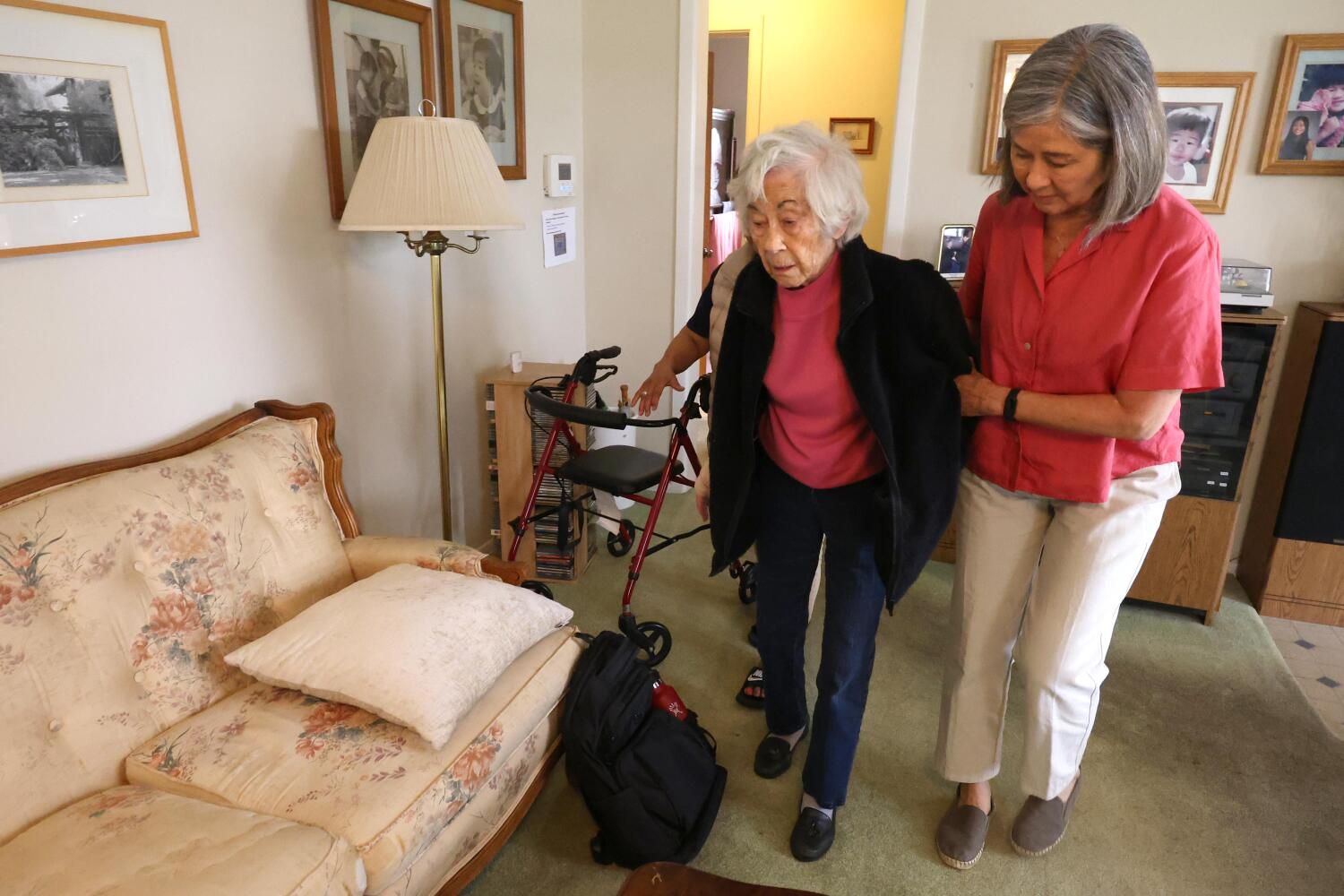
Marian Sunabe drives from her home in South Pasadena to visit her 100-year-old mother in Gardena once a week or so, and I tagged along on a recent morning to talk about the crypling cost of elder care.
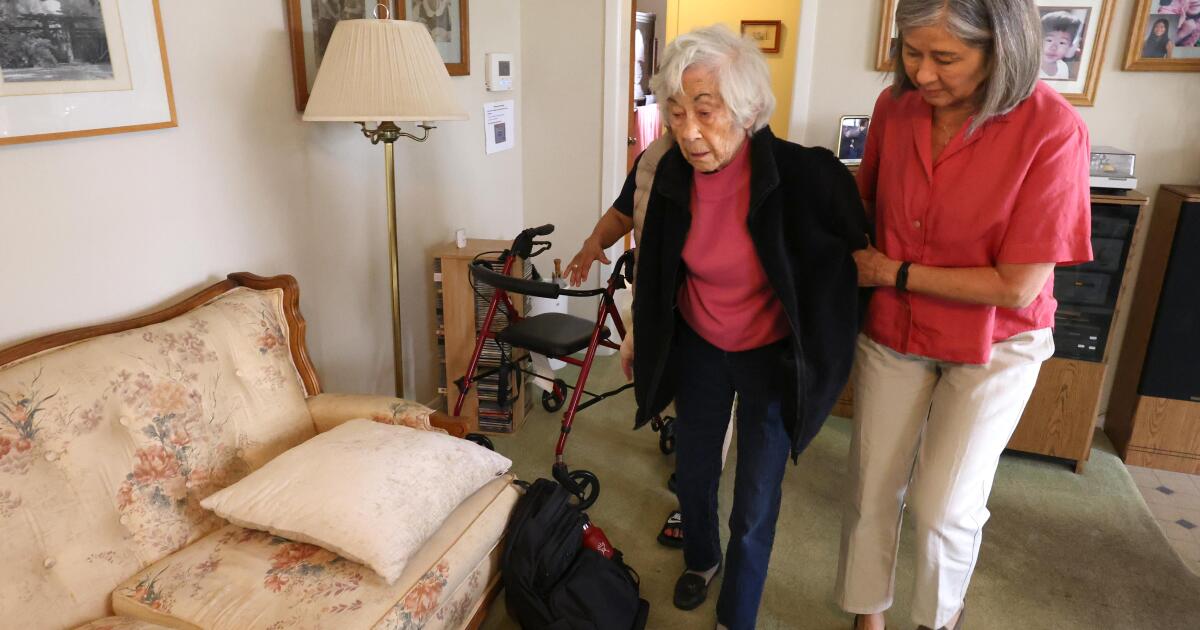
Sunabe, a retired school psychologist, said her mother is independent-minded, loves the comfort of her own home and doesn’t want to move in with Sunabe or her brother. For the last four years, Reiko Kobata has had a daytime caregiver. But lately, after taking a fall and getting sick with pneumonia, there are times when a nighttime caregiver has been added.
The daytime tab, for a 13½-hour shift, is $320. The 11-hour nighttime shift costs just under $300, bringing the daily total to $620.
Reiko Kobata, 100, enjoys a visit from her daughter, Marian Sunabe.
(Genaro Molina / Los Angeles Times)
That adds up to a staggering $18,600 a month. When the night shift caregiver isn’t needed, the amount is about half that.
“Most folks would not be able to afford this. But there aren’t many options other than admitting them to a board and care facility,” Sunabe had said in an email, and even that can run several thousand dollars a month. “I’ve known people who have had to quit their job … to care for their aging parent. It can easily drain all of your savings and assets — not a good system.”
In fact, it’s a national crisis, and the United States lags behind many developed countries at a time when the global population is rapidly aging.
“Americans are not prepared for the challenges of caregiving,” Paul Irving, a senior advisor at the Milken Institute, says in “Caregiving,” a new PBS documentary. Families ultimately learn, he says, that essential care is not covered by health insurance, “so incredibly, more and more middle-class Americans are forced to pay down to poverty so that they can qualify for Medicaid. That’s a crazy system for them and for our federal government.”
And it might not be an option much longer, given the hatchet job on Medicaid by the Trump administration and Congress.
As Sunabe and I drove south, I told her about my friend Morrie Markoff, who lived to 110. He was fortunate to have saved enough for in-home care that cost $14,000 a month. But he and Sunabe’s mother are not the norm. I’d also written about 102-year-old World War II vet Paul Hult, who quickly burned through his life savings after taking a fall and needing in-home care.
Sunabe had neatly penciled columns of numbers for me on a sheet of lined paper, outlining the math of her mother’s care. Kobata was pooling Social Security, income from a rental property she and her late husband owned, pencils, long-term care insurance and retirement savings to cover the monthly $18,600 bill.
Reiko Kobata, 100, holds a photo of herself at 29 years old in her home in Gardena.
(Genaro Molina / Los Angeles Times)
Kobata pays an agency that provides, and in turn compensates, the caregiver. In such arrangements, agencies take as much as half the total. That can leave something close to minimum wage for the caregiver, making it hard to recruit more of them to an industry with a critical workforce shortage.
As a result, many caregivers are undocumented and work off the books. That saves clients money, because there’s no split with an agency. And a lot of caregivers get free room and board while on duty, but sacrifice their own privacy and time with family.
Women from the Philippines — some with legal status, some without — make up a sizable portion of the workforce in California. As I’ve reported, some of them share barracks-style housing, and many are living in fear of deportation at the moment thanking to the Trump administration’s immigration raids.
So what we’re witnessing is a colossal public policy failure, and it’s not as if the age wave — cresting for decades — could have come as a surprise. The Public Policy Institute of California projects that in 2040, the number of Californians 65 and older will hit 9 million, representing 22% of the population, up from 14% in 2020.
By necessary, more and more families will resort to an approach fairly common in immigrant cultures. They’ll take care of their own, live together, do a lot of juggling and hope that when the need arises, they won’t be bankrupted by medical care.
Sunabe exited the 110 Freeway and drove through Gardena streets where she used to walk to school. As we approached the family home, she told me her mother still likes to personally write checks to pay her bills, but doesn’t keep track of the total cost of her own care.
“Sometimes she’ll ask, ‘What is all this money going for?’” Sunabe said.
Sunabe parked in the driveway of the house she grow up in. Her parents buy it about 65 years ago for $13,000, when Harold Kobata worked as a chemical engineer and his wife was a teacher’s aide and school office assistant.
Kobata entered the living room with the aid of a walker, but otherwise appeared to be in miraculously good health and even better spirits. Her grandson, who stays with his grandmother when he works as a sushi chef at a nearby restaurant, was leaving for his shift.
Reiko Kobata looks over a photo booklet that her family made for her 100th birthday in the living room of her home in Gardena.
(Genaro Molina / Los Angeles Times)
Kobata settled onto a comfortable sofa against a wall of family photos. She told me she enjoys a morning walk through the neighborhood and likes to spread out the LA Times each day and read the whole paper, front to back. She tends to her garden, plays solitaire on her computer, follows the Dodgers and has a favorite player — Shohei Ohtani.
I told Kobata she didn’t look 100.
“How do you feel?” I asked.
“I don’t know,” she said. “How are you supposed to feel?”
She thought about it and said she feels about 90.
We had a lovely visit, going on two hours, but I didn’t want to keep Kobata from her nap. On the ride back to South Pasadena, Sunabe said her mother’s situation is sustainable for the time being, but she wonders about the broader social challenge.
“If you’ve been in a house for a long time, so long that you don’t want to move out of it because it’s so comfortable and familiar, then you probably have a fortune in equity,” she said. “And if you were to downsize or move into a more communal setting, you’d solve the isolation problem and the care problem by cashing out that equity.”
That’s an option for some people, along with unpaid help from relatives or friends, and a state program providing limited care for low-income and olderly residents.
But there are no easy or inexpensive solutions, according to Irving and to UCLA professor emeritus Fernando Torres-Gil, who also appears in “Caregiving” and says that when he’s asked for advice on elder care, he has a two-word response: “You’re screwed.”
In the middle of the last century, Torres-Gil said, the US invested heavily in institutional care, enabling “a huge for-profit industry to take hold.” Other countries instead invested in public financing of community-based and home-centered care, including Singapore, Japan, Taiwan and South Korea.
“We are behind the curve,” Irving said. “We are the only developed country … without a system of universal health care, leading to high rates of chronic disease and shorter health spans and life expectancy … And the system — if you can call it a system — fails our elders. Assisted living communities and nurse homes are unaffordable for most Americans.”
The only hope, ironically, may be the age wave itself. As more and more people wipe out, policymakers might discover the cost of ignoring their cries for help.
steve.lopez@latimes.com
[ad_2]Source link
